
 sign up
The Ultimate WMS Guide 2026: Eliminating 99% of Picking Errors
Introduction (The Hook)
In modern logistics, the profit margin is lost inside the warehouse. A recent study shows that a single picking error (sending the wrong product) costs a distribution company, on average, €50 (round-trip transport, repacking, product depreciation, administrative time). If you have 100 errors per month, you lose €5,000 directly from your net profit.
This guide explains, in technical detail, how e:corg ERP transforms a chaotic warehouse into a precise mechanism using digital validation.
Why Errors Occur — The Anatomy of Human Mistakes
It’s not the warehouse workers’ fault.
It’s the fault of the process.
Visual fatigue: Product codes (SKU) often differ by just one digit (e.g., 100-A vs 100-B). After 4 hours of work, the human eye can no longer distinguish details accurately.
Lack of real-time validation: On paper, mistakes are discovered only when the customer files a complaint.
Memory-based picking: Long-time employees believe they “know” where products are located, but locations change.
The Technical Solution — 3-Step Validation Through WMS
e:corg ERP doesn’t just “suggest” what you should pick.
The system forces the operator to follow a strict protocol:
Step 1: Location Scan (Bin Location)
The system tells you: “Go to shelf A-12-3.”
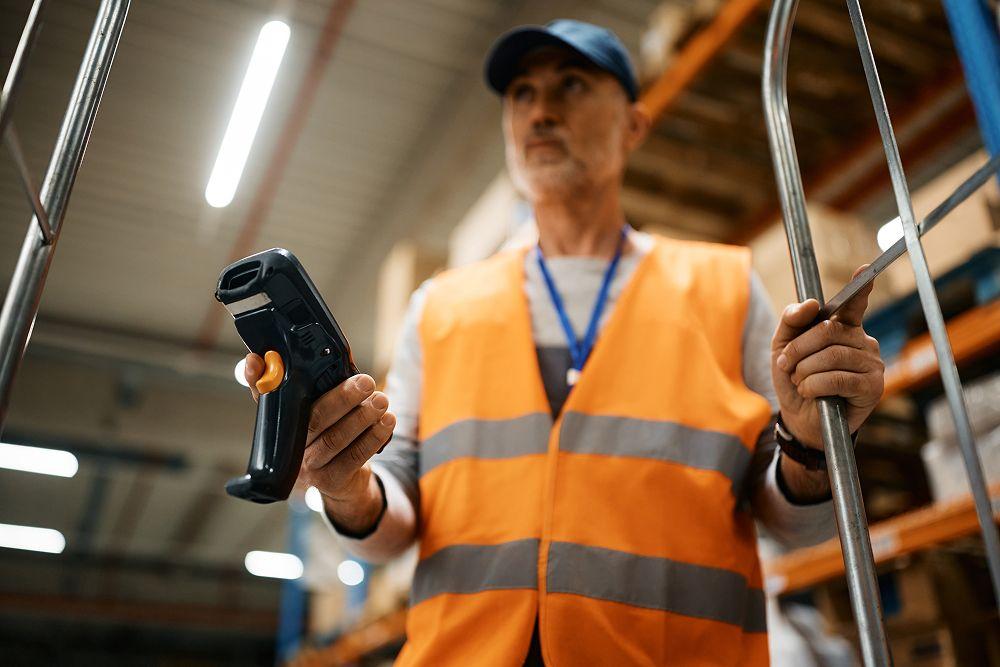
The operator must scan the bin label.
If they are at the wrong shelf, the scanner blocks the process.
Step 2: Product Scan (Item Verification)
The operator scans the product.
The system checks the EAN code in the database.
Step 3: Serial/Lot Scan (FEFO)
For products with expiration dates (food, chemicals), the system instructs:
“Pick the lot that expires first.”
This eliminates losses caused by expired stock (First Expired, First Out).
Case Study — Optimizing Picking Routes (Wave Picking)
How do you reduce employees’ walking time by 40%?
Instead of processing one order at a time, e:corg groups 10 orders simultaneously (Batch Picking).
The system generates an optimal route through the warehouse so that the employee passes each shelf only once to collect products for all 10 customers.
Integration with Couriers and e-Transport
Once the parcel is closed, e:corg communicates via API with Fan Courier/Sameday.
• The AWB prints automatically.
• If the goods are fiscally high-risk (e.g., clothing, vegetables), the system queries ANAF servers and retrieves the UIT code, which is printed on the delivery note.
• No human intervention required.
Conclusion
Digitalizing the warehouse is not a cost — it is an investment with a 3–6 month ROI.
Want to calculate how much you are losing right now?
👉 Request a Free Logistic Audit with the e:corg specialists.